Chapter 1
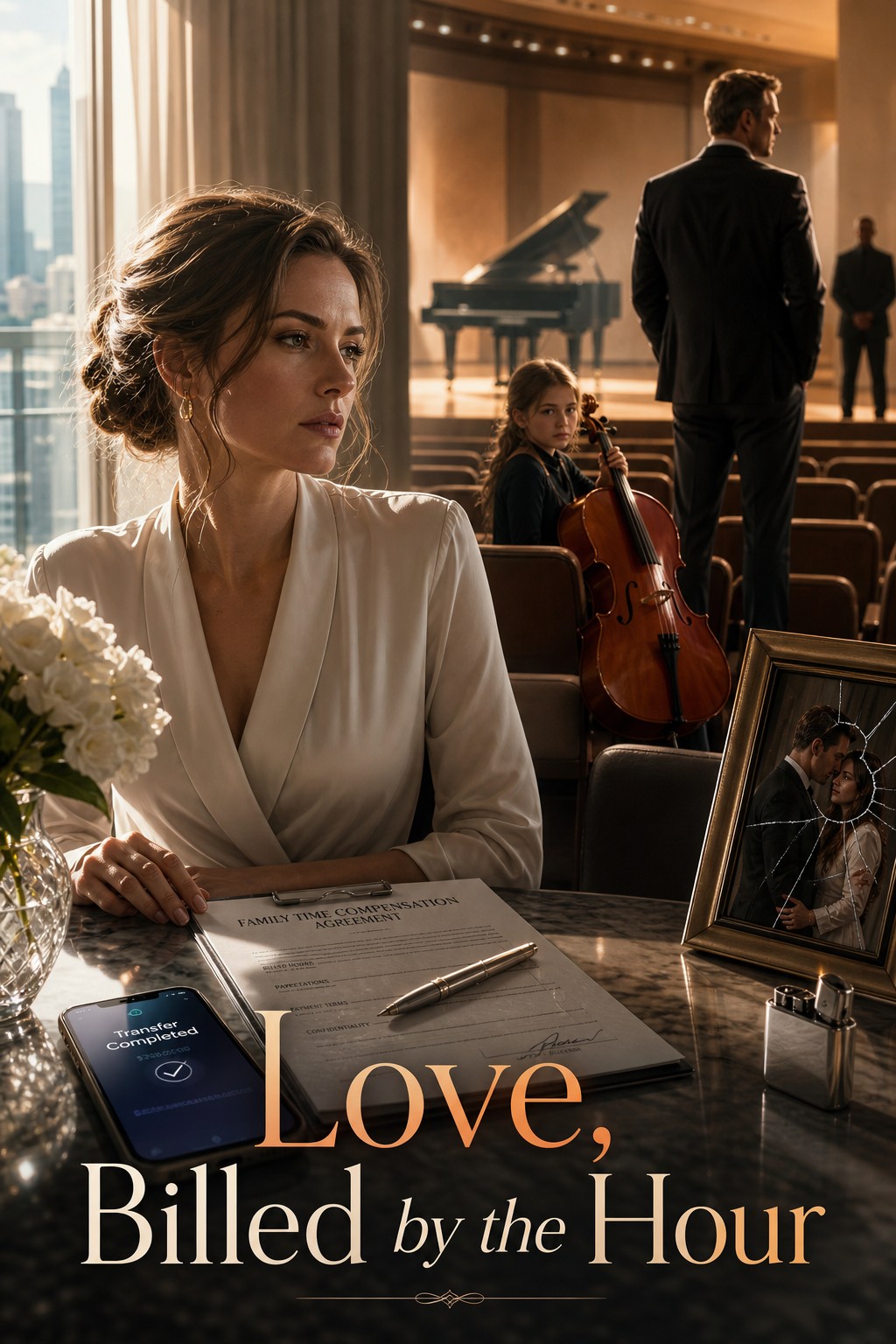
After my husband missed our son's performance for the third time, I set a contract on the dining table.
The contract didn't fight for custody, and it didn't divide property.
I had simply put a price on every one of his departures.
Canceling a family dinner: fifty thousand dollars.
Missing our son's performance: one hundred and fifty thousand dollars.
Rushing off to protect another woman when we needed him most: two hundred thousand and up.
He read the terms and signed his name in silence.
He thought it was a wife's revenge in the seventh year of marriage. He naively believed that as long as he was willing to pay, I hadn't truly given up on him.
He was wrong.
The numbers flowing into that account weren't a childish demand. They were the way out I was buying for myself and my son.
His first love, the woman he saw as his savior's daughter, was destroying our family, inch by inch.
Later, when the truth came out, he wanted to spend the rest of his life making it up to me and the child.
But we no longer needed it.
Chapter 1
When I pushed the bill across the long table, Gabriel was fastening his cufflinks.
The black evening suit set off his straight back, and the silver-gray tie was one I had picked for him in Milan three years ago. Tonight he was supposed to go with me to Lincoln Center. It was the tenth anniversary of the day we met, and our son Noah's first time on stage with his cello.
His phone lit up.
Sophia had sent a voice message just six seconds long. Breaking glass, a child crying, and her voice saying someone had fired a shot at her apartment door.
Gabriel didn't leave at once. He called family security first and had them confirm the address, then bent to look at me. "Elena, I'll drop you two at the concert hall, then go."
"Forty minutes to curtain." I turned the payment code toward him. "Anniversary, triple rate. Estimated three hours. One hundred and fifty thousand dollars."
Something in his face tightened.
Once I would have demanded answers, cried, grabbed his coat and asked why Sophia always mattered more than us. Now I only discussed price.
He transferred the money and bent to kiss my forehead. I turned my head to adjust an earring, and the kiss landed on air.
"Wait for me," he said.
"No need." I gave a small smile. "Your time has already been sold."
Noah sat on the stairs with his cello case in his arms. He was eight, thin as a reed bent by the wind, with eyes exactly like his father's.
"Is Dad not coming?"
Gabriel crouched and met his eyes seriously. "Aunt Sophia's family might be in danger. As soon as I've handled it, I'll come. Front row."
Noah didn't cry. He took his kids' debit card from his jacket pocket and held it out to his father.
"I have two thousand one hundred dollars. Dad, can you sell me the last half hour?"
Gabriel's face finally changed.
"Who taught you to say that?"
"No one." Noah took the card back and lowered his eyes, stroking the edge of the case. "Mom says we can't force people to love us. If you want his time, you buy it by his rules."
I didn't explain.
Five months earlier, Noah had collapsed at school and been diagnosed with a complex congenital coronary malformation. The surgery date kept being pushed back. Gabriel controlled the Moretti family trust. I had given up my career after the wedding to raise our child, and my personal account didn't even hold six figures.
I couldn't keep betting my son's life on whether a man would come home.
That night, while Noah played "The Swan," the seat in the middle of the front row stayed empty.
After the performance, Gabriel sent a message: the shooting was a misunderstanding, just a metal flowerpot that had fallen from upstairs. Sophia was shaken, and he would stay until the police finished their report.
I replied: Forty-seven minutes over. Bill goes out in the morning.
Then I turned off my phone and watched Noah bow to an empty seat.
After the applause died, he stood at the edge of the stage for a few seconds longer, as if waiting for someone to step out of the dark.
His music teacher draped his coat over his shoulders and praised him for holding the last long note even after switching bows mid-piece. Only I knew that before he went on, Noah had taken a video call from Luca. Luca held up the baseball glove Gabriel had given him and asked with a grin, "Your dad's mine again tonight. Are you going to mess up?"
Noah's hands were shaking when he hung up, and half the hair on his bow had snapped.
I didn't tell Gabriel. Every time I had shown him the malice of Sophia and her son, he checked first whether the video had been edited, whether the child had been coached. His caution was invincible in a courtroom. In a marriage, it meant every wound had to pass an evidentiary review before it earned comfort.
At midnight, he finally came home. No perfume on his collar, only a police report in his hand and a silver metronome for Noah.
"Is he asleep?"
"Your three hours are over."
"Elena, I wasn't on a date."
"I know. You were repaying a life from fifteen years ago." I handed him the overtime bill. "But Noah only gets to be eight once, and tonight was it."
He didn't argue. After the transfer, he set the metronome by the child's door and went to the study.
At two in the morning, muffled piano came from inside. He was playing Noah's piece from tonight, without a single wrong note.
He remembered every bar of his son's music, but he had missed the one time his son truly played it for him.
Chapter 2
Sophia hadn't burst into our marriage out of nowhere.
She and Gabriel grew up on the same street in Brooklyn and were each other's first love at fifteen. His father was in prison then, his mother had died of illness, and he washed dishes at a restaurant and finished prep school on scholarships.
Sophia saw no end to the poverty. The summer Gabriel received his acceptance letter from Columbia, she climbed into the sports car of the developer Victor Bellini and never looked back.
A year later, I met Gabriel at the university's legal aid center. He had a shirt washed pale, a pair of leather shoes coming unglued at the soles, and an old piano in storage in a basement.
My father guaranteed his first apartment, and my mother cooked for him for four years. I sold the sapphire brooch my grandmother had left me to pay for his first bar exam prep course. The first time he won a moot court, he ran off the stage and hugged me, and said he would never let me lose in this life.
He truly had loved me, clumsily and grandly.
In my second year of college, my father's architecture firm was stiffed by a client, and the family hit its first cash crisis. Gabriel took classes by day, worked shifts at three restaurants by night, and stuffed all the money he'd saved for the international moot court competition into my father's office mailbox. He didn't sign it. All he wrote was, "Returning the spring the Hart family lent me."
I recognized his handwriting and sent the money back. He stubbornly sent it again, and we argued outside the library until late at night.
"You don't owe us," I said.
"Then how do I repay you?"
"When you've succeeded, don't become the kind of lawyer who recognizes contracts and not people."
He smiled and held out his little finger. "Deal."
Later my father weathered the crisis, and Gabriel won prize money in a competition. Before the final, his only pair of leather shoes came apart, and I crouched in the stairwell gluing them back together with superglue. He stood rigid, not daring to move, and said quietly that when he had money he would buy me an entire shoe store.
"I don't want a shoe store."
"Then what do you want?"
"I want you to look back at me first, every time you win."
He won that competition. When the applause rose, he really did look past the judges and his classmates and pick me out of a crowd of hundreds.
For a long time after we married, that was our signal. In a courtroom, at a charity gala, at a family gathering, whenever he was surrounded, he would look back at me first.
After Sophia came back, he still looked back. Only there was always something between us. A ringing phone, a document waiting for a signature, someone who needed protecting.
The love hadn't vanished. It had simply been pushed to the back of the line by too many things that were "more urgent" than us.
We married in the campus chapel. On the piano he played a piece he had written himself, called "Elena's Morning." For the first three months after Noah was born, he barely slept a full night.
The change came in the sixth year of our marriage.
Gabriel's uncle was assassinated during a shift of power in the family. The police couldn't protect the Moretti elders and children, and he had no choice but to take over as the family's legal counsel. He promised me it was temporary, but he began spending whole nights on litigation, assets, and ceasefire negotiations.
In the same period, Sophia divorced and returned to New York with her seven-year-old son, Luca.
She brought a rusted silver lighter. It had belonged to her father, Antonio.
When Gabriel was seventeen and enemies came to kill him, Antonio had hidden him in a wine cellar and taken a bullet for him. On his deathbed, the old man had made only one request: if Sophia ever had nowhere to go, look after her.
Sophia also produced medical records of Victor's abuse, stalking photographs, and bloodstained threatening letters. Gabriel had a private lab examine them. The ink, the fingerprints, the ballistics all matched.
He didn't fall in love with her again. He never spent a night alone at her home, never accepted a touch that crossed a line, and every bit of support came with bodyguards present.
But he believed he owed her father a life, and he believed the danger was real.
He didn't know that the head of the lab owed Sophia three hundred thousand dollars in gambling debts.
Neither did I, at the time.
I only knew that Gabriel explained himself to me every time before he went out, and never once stayed because I asked him to.
At first, his help really did have boundaries.
He applied for a protection order for Sophia, arranged a school for Luca, and assigned female security around the clock. He showed me the bills, and even asked me to sit in on the security assessment.
At the meeting, Sophia was impeccable from beginning to end. She called me "the luckiest thing in Gabe's life" and said she only wanted to keep her son alive. As the meeting broke up, she saw the campus photograph on the wall and suddenly laughed. "He was so thin then. On our dates we had to share a single cup of hot chocolate."
She was speaking of memories, but her eyes stayed on my face.
Only later did I understand. She was in no hurry to take Gabriel. First she had to prove that in his poorest, most vulnerable years, she had come before me.
The real crossing of the line came after a family funeral. The Moretti convoy was ambushed and Gabriel's driver was shot. He came home in the small hours with his shirt covered in someone else's blood. I tried to tend his wounds, and he pushed me away by reflex and sent us into the panic room first.
That was when Sophia sent him a recording of Antonio before his death. The old man lay in a hospital bed, repeating that they must not let his daughter fall into those people's hands.
From the next day on, Gabriel personally took charge of her security. Not out of rekindled feeling, but because the driver's blood had reminded him that an old debt could become a new grave at any moment.
Sophia had chosen his most fearful moment with precision. She knew that the more he loved us, the less he dared bring his weakness home. And the more he shut me out of the truth, the more the only person he could explain himself to was the old flame who "understood" the family's dangers.
Chapter 3
A marriage doesn't die suddenly on one particular night.
It starts to rot from things too small to notice.
Gabriel stopped playing the piano. When he came home, he checked the window locks first, and he slept with a gun by the bed. When he woke in the night, he would stand alone on the terrace until dawn. He was afraid of bringing the family's blood home to me, so he never told me what was happening.
I hid all my anxiety in the calendar. Noah's medication, checkups, school events, my husband's court dates. We were becoming more and more like a tightly run company.
On the night of our seventh anniversary, I tried to break the silence.
"When this case is over, let's leave New York," I said to him. "I can go back to architectural acoustics. You can just be a lawyer. Noah needs a father who doesn't vanish in the middle of the night, and I need a husband."
He was silent a long time, then said, "If we leave now, the people watching the Moretti family will follow us. Staying inside my protection is the safest thing."
"You always say protection. But you never ask whether we want this life."
At the worst point of the argument that day, Sophia sent a photograph of Luca pinned against a car door by a stalker.
Gabriel said only "lock the doors," and left.
The next day, at the hospital, I heard that Noah would need surgery. When I got home, I saw a news photograph of Gabriel draping his coat over Sophia's shoulders.
I asked for a divorce for the first time.
He didn't agree. He thought I was deciding out of fear, and he decided that my hostility toward Sophia would expose our weak points. He froze the authority to make large transfers out of our joint account and moved Noah and me into an even tighter ring of security.
It wasn't meant as punishment, but it cut off the last shred of control I had.
I smashed our wedding photo in hysterics and asked whether he had to wait until we were dead before he would believe.
He stood in the broken glass, exhaustion in his eyes. "Elena, you can't hear any explanation right now. When you're calm, we'll talk."
In that moment I understood. Tears couldn't make him stop. They only became evidence that I was "not calm enough" to be heard.
So I stopped crying.
I drafted a Family Time Compensation Agreement. Whenever he canceled a family commitment for Sophia and her son, he had to pay into my independent account.
He signed.
He thought money could reassure me. He thought that if I was willing to name a price, I was still willing to wait.
And every payment went into an account called "North," and nowhere else.
The night before I drafted the agreement, I had gone to his office.
At one in the morning, the lights were still on at the top of the firm. Through the glass, I saw Gabriel sitting alone at the piano, an offer from a Boston firm spread on the desk beside three listings for houses in Maine.
So he had heard me say I wanted to leave.
I waited outside the door for ten minutes. When Sophia called, he closed the folder and left with his bodyguards without seeing me.
The next day, all three houses were bought by an unknown buyer. I thought he had given up on us again. Only many years later did I learn the buyer was him. He wanted to finish clearing away the Moretti loose ends, then give me a home with no cameras and no guns.
But he never told me.
Our greatest tragedy wasn't that we didn't love each other. It was that he treated the future as a surprise, and left the present for me to get through alone.
When the agreement was signed, he added one clause of his own. "If I leave for a genuine family emergency, the fee is still payable, but Elena holds the final veto."
I asked, "If I veto, will you stay?"
"As long as it won't bring danger to you and Noah."
That still wasn't a "yes" at all.
He signed with the fountain pen I had given him at my college graduation, then changed the account permissions so that only I could withdraw.
"Does that put your mind at ease a little?"
"Yes."
I lied. And he mistook my calm for reconciliation.
That was the place Noah had set his heart on. A quiet little town on the coast of Maine, with no Moretti family, no Bellini family, only a lighthouse, pine woods, and a very long winter.
Chapter 4
A month before Noah's surgery, Sophia's apartment exploded.
Gabriel had security seal off the block first, then brought her and Luca back to our townhouse. He didn't decide on his own. He stood on the porch and asked me, "Seventy-two hours at most. The basement safe room is bulletproof and has its own exit. I'll pay a separate fee for the space."
His restraint almost reminded me of before.
"Two hundred thousand dollars," I said.
The money arrived quickly.
The first night passed without incident. The next day I brought Noah home from a checkup and found the lock on his door had been changed.
The housekeeper, plainly uncomfortable, said security had received instructions: the street-facing bedrooms carried a sniper risk, and all the children had to be moved. Luca had severe claustrophobia and couldn't stay in the basement, so he had moved into Noah's room. Noah's things had been carried into the storage room.
Gabriel was delivering closing arguments in federal court, his phone off.
Sophia, wearing my cashmere loungewear, stood on the stairs and apologized. "Gabe doesn't know the details. He only said to do everything according to the security chief's plan. You wouldn't distract him in court over a room, would you?"
Noah said nothing. He walked into the storage room and picked up the wooden music box from the floor.
Gabriel had made it for him with his own hands. The lid was cracked, and the tiny piano inside no longer turned.
Luca leaned in the doorway. "It's just an old toy. My mom will get Uncle Gabe to buy you a new one."
Noah hugged the music box and asked me calmly, "Mom, do we charge for the storage room too?"
It felt like a dull knife opening my chest.
At eleven that night, Gabriel finally came home. When he saw the luggage in the storage room, his face darkened, and he had the room restored at once.
Sophia produced a forged security report. According to it, I had refused to let Noah go to the safe house outside the city and insisted on staying in the main residence. She had made the temporary adjustment for the safety of both children.
"Elena," Gabriel said quietly, "you can be angry at me. But don't gamble with Noah's safety."
He didn't shout at me. He didn't throw anything. He even carried the sleeping Noah back to the master bedroom first.
But precisely because he was so calm, the misunderstanding cut all the sharper.
"You believe this piece of paper, and not me?"
"I believe evidence."
"Good." I nodded. "Then remember you said that."
That night I packed my passport, Noah's medical records, and my mother's design manuscripts into a suitcase.
On the morning of the third day, the police confirmed the explosion had come from a deliberately sabotaged gas valve. The cameras happened to be broken, and Sophia was once again the sole victim.
Only I had smelled the faint machine oil on her coat in the basement.
I pulled the doorbell footage. An hour before the explosion, Sophia's car had briefly left its security route. The footage showed only a cracked right taillight.
I gave the screenshot to Gabriel. He had the technical team recover footage along the route at once. Two hours later the conclusion came back: the plate belonged to another car of the same model, and the driver couldn't be identified.
"And the taillight?"
"There are tens of thousands of that model in New York," he said. "It can raise suspicion. It can't support a conclusion."
Sophia immediately offered to leave, saying she didn't want to be the cause of our arguments. Gabriel agreed. Her shock showed for only half a second before Luca came rushing downstairs, screaming that someone outside was aiming at him. A red dot appeared on the glass at exactly that moment.
Security forced everyone to the floor. Gabriel threw himself over Noah and me first, shielding the window with his body. On the roof across the street, all they found was a laser pointer on a timer.
In the confusion, Sophia clung to him. He pried her hands off at once and turned to check whether I was hurt.
"Look at me, Elena. You're safe."
In that moment I could still see the love in his eyes.
And that was exactly why I despaired all the more. Sophia didn't need to change his heart. She only needed to keep manufacturing danger, so that his love was forever busy putting out fires, and never had time to stay.
Chapter 5
On the anniversary of my mother's death, I took Noah to Green-Wood Cemetery.
A bouquet of red roses already lay before the headstone. The card was in Gabriel's hand: Thank you for once giving me a home.
He hadn't forgotten.
When my mother died seven years earlier, he had knelt by her bed and promised to love me and our children the way she loved me. I had always assumed that promise had been worn away by the gunfire of New York.
As Noah crouched to wipe the corner of the stone, two workers came pushing a cutting machine. They held a relocation authorization with my signature on it. The reason given was that the Moretti family was expanding its private burial plot.
"This is forged." I put myself in front of the headstone.
Before the workers stopped, Sophia's car drove in. She was carrying the urn of a white dog, and said Luca could only recover from the trauma of the explosion if the dog he had grown up with was buried here.
"Gabe agreed." She showed me an email. "He said since you can put a price on everything, the grave can be negotiated too."
The email came from Gabriel's private address, and the tone was flawless.
I still didn't move.
In the scuffle, Luca kicked over the candlestick in front of my mother's grave. Sophia pretended to pull him back, but her elbow knocked the ash niche loose. The stone cover shattered, and gray-white powder spilled into the rain.
I rushed forward, tripped over the foot she slid out on the sly, and hit my forehead on the headstone.
Noah screamed and threw himself over me. But Sophia dialed the police first, saying I had threatened a child with a knife. She even took a gardening knife from my tool basket and pressed onto it a fingerprint she had stolen in advance.
Gabriel arrived before the police car did.
He saw the blood on my face at once, took off his coat and wrapped me in it, and gathered my mother's ashes into a clean silk scarf with his own hands, bit by bit. Sophia wept and displayed the scratch on Luca's arm and the knife.
"Not Mom!" Noah screamed hoarsely. "She pushed her!"
Gabriel looked at Sophia, his eyes cold as ice. "Take Luca to the car. Now."
It was the first time he hadn't comforted her.
But the police had to go by the evidence. Gabriel vouched for me, called in lawyers, and had me released in under two hours.
On the drive back, he gripped the wheel, his knuckles white.
"I didn't send that email. I'll find out who did."
"Do you believe I didn't hurt Luca?"
He was silent for two seconds.
"I believe you wouldn't hurt a child on purpose. But the footage is missing, and your prints are on the knife. I need to know what happened in between."
I looked out the window and suddenly found I didn't even have anger left.
He loved me, and he would always wait for evidence to speak for me.
But the truly dangerous person had long since learned to manufacture evidence for him.
Gabriel took us to the hospital and stayed himself until Noah's fever broke. In the small hours, the technicians confirmed the cemetery email had been sent from the family tablet. For the past three days, that tablet had been in the bedroom.
"The only people in the house are you, me, Noah, and two vetted staff." He stated it as fact, without accusation in his tone, and it was more suffocating than an accusation.
"And Sophia."
"Her access doesn't reach the bedroom floor."
"You granted the access, and your people installed the system. You'd rather believe the system can't be wrong?"
He rubbed the bridge of his nose. "I'll check everyone. Including her."
"But you won't stand on my side first."
"Standing on your side doesn't mean skipping the facts."
I smiled. A marriage isn't a jury. What I needed wasn't for him to falsify the verdict. It was for him not to leave me alone in the dock while the verdict was still out.
The next day, he suspended all of Sophia's electronic access and gave my mother's ashes to a restorer. He really was solving the problems.
But when Noah woke in the night, what he asked was, "Does Dad think Mom did something bad?"
A child doesn't understand a chain of evidence. He only understands that his father never said "I believe her" out loud.
Chapter 6
After we got home, Noah ran a high fever.
When I changed him into his pajamas, I saw a dense cluster of needle marks on the inside of his arm. They weren't from the hospital. They were too shallow, with no trace of antiseptic.
At first Noah wouldn't talk. Only after I promised never to let him see Luca alone again did he take an empty syringe from under his pillow.
"Luca said it was a bravery game. Every time he stuck me, he gave me twenty dollars."
"Why did you want the money?"
He dragged a cookie tin out from under the bed. Inside were crumpled bills, birthday checks, and a children's savings passbook, totaling forty-eight thousand seven hundred and thirty dollars.
"I wanted to buy Dad for one day," he said. "The day of the surgery, from when I go in until I wake up. I asked his assistant. A whole day costs about fifty thousand dollars."
That was the moment my heart broke, all the way through.
I gave the syringe to Gabriel. He called in the doctor and security at once, ordered blood tests, checked the door logs, and isolated Sophia and her son.
But the results the next day showed only sterile saline in the syringe. The door logs showed Noah had gone into Luca's room many times on his own. And a child psychologist issued a report saying Noah might be exaggerating his memories because of conflict between his parents.
That psychologist sat on the board of Sophia's ex-husband's foundation.
Gabriel didn't blame Noah. He sat by the bed a long time and said softly, "Whatever that game was, you're never to play it again. I'll protect you."
Noah asked, "Will you come on the day of the surgery?"
"Yes." He didn't hesitate.
"Without paying?"
Gabriel swallowed. "Never again."
It was the first time in months I saw Noah truly smile.
But that same night, Sophia sent another piece of footage. Edited, it looked as if I had sent Noah into her room to steal the threatening letters. She knelt in the living room and said she was willing to leave, and only begged Gabriel not to take his anger over her old debt out on Luca.
Gabriel didn't ask her to stay. He only arranged for her to move into a family safe house. He made the right decision, and still said to me, "Elena, if you suspect her, bring me the evidence. Don't let Noah get dragged into a war between adults."
I looked at him and finally understood why our marriage couldn't be saved.
Every time, he was more careful and more rational than before.
But the starting point he set was always that I might be the one in the wrong.
Chapter 7
On the day of the surgery, Gabriel was at the hospital by five in the morning.
He helped Noah into his gown and put the passbook back into his son's hands. "Keep your money for your first car. Today Dad isn't going anywhere."
I very nearly believed fate would let us be.
At nine, the anesthesia began. At nine twenty, a gunfight broke out at a Moretti warehouse and a witness was taken hostage. The federal prosecutor demanded Gabriel appear in court immediately, or the protection agreement would be void and a dozen innocent relatives in the family would be exposed.
He stood outside the operating room and didn't move.
"Send my deputy," he said.
But the other end of the line played a recording: the hostage crying out that Sophia and Luca were in the warehouse too.
Gabriel looked at me, and for the first time there was something close to pleading in his eyes.
"I'll be back in forty minutes. There are six security staff here, and the surgical team won't leave. Elena, I have to stop more people from dying."
I didn't take payment, and I didn't stop him.
"Go," I said. "This is the last time."
He kissed the operating room door and turned away.
Ten minutes later, the hospital fire alarm went off. Someone, in the name of the Moretti legal office, reported a bomb in the underground garage, produced Gabriel's electronic seal, and ordered the hospital to evacuate the cardiac surgery team first.
The lead surgeon refused to leave. Right after, he received a live video of his daughter being kidnapped.
That was fake too, but no one knew it at the time.
The surgery was forced to stop. Noah's chest was still open, and the numbers on the bypass machine kept dropping.
I called Gabriel. Every line was diverted to a fake voicemail. My texts showed as read, and the only reply was one line: Evacuate according to the emergency plan, and stop creating chaos.
He hadn't written it.
At the time, I thought he had.
Then Sophia sent me a video. She sat in the safe house, Luca eating ice cream beside her.
"Sign the divorce agreement and give up your beneficiary rights to the Moretti trust, and the doctor will come back."
"This isn't for Gabe," she said softly. "It's for Luca. Victor is bankrupt. My son can only inherit everything the Moretti family has."
"Luca isn't Gabriel's son."
She smiled. "Blood doesn't matter. It's enough that everyone believes it."
The documents came through. I signed without reading a page.
Then I triggered the second plan I had prepared long before.
My mother had helped design St. Catherine's Private Hospital before she died. I knew the surgical floor had a fire corridor that didn't appear on the public drawings. For three months, using the "rent," I had anonymously funded an independent cardiac surgery team, standing by two blocks away.
Twelve minutes later, they came in through the fire corridor.
The hallway outside was full of reporters. Sophia had leaked in advance that I had deliberately halted my son's surgery to fight over property. Cameras, questions, and flashbulbs choked the exit.
I didn't explain. I only held Noah's cold hand and watched the second team reconnect the machines.
When the monitor let out its long tone, I thought I had died once myself.
After the replacement team took over, the hospital went into a real lockdown. The police found no bomb, but they found a remote module planted in the fire control cabinet. The reporters were still blocking the doors, and a secretly filmed video had already surfaced on social media, showing me stalling the surgery and extorting my husband.
The video came from the family waiting room. In it, I signed the divorce papers, but Sophia's threats couldn't be heard. All you could see was her crying and me pushing the papers back across the table. Public opinion reached its verdict quickly: a greedy mob wife using her sick child to fight for money.
I turned off my phone and stopped trying to clear my name.
The surgery lasted seven hours. When the doctor came out, his mask was soaked with sweat. He told me Noah's heart had stopped three times, and it was lucky that matched blood had been stocked in advance. That blood came from the backup blood bank I had set up with the very first "rent" payment.
I slid down the wall to the floor and only then noticed my knees and palms were covered in blood. When the alarm went off, I had thrown myself in front of the people trying to move Noah and shattered a glass door doing it, and I had never felt the pain.
Late that night, the lawyer brought the formal divorce papers. "Signing means losing a great deal," he reminded me.
"What I almost lost was already the most anyone can lose."
I signed my name and immediately applied for sole custody and a protection order. No thunder, no argument, no tears. Seven years of marriage ended with nothing but the scratch of a pen on paper.
Three seconds later, the heartbeat returned.

 GoodNovel
Completed